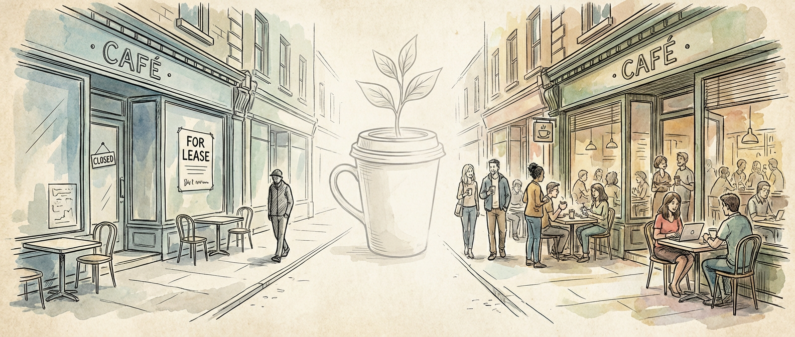
When the Coffee Shop Becomes a Ghost Story
There’s a specific kind of silence that fills a storefront after the lights go out for the last time. I watched it happen to three neighborhood cafés in my city over the past eight months, each one a small death in the urban ecosystem. The first was a place where I’d spent countless afternoons working on stories that never went anywhere, surrounded by the ambient hum of other people doing their own thing. The second was where the owner knew my order before I ordered it. The third was where I first heard about underground music venues that would later become legendary, whispered about by regulars who actually paid attention to culture instead of just consuming it.
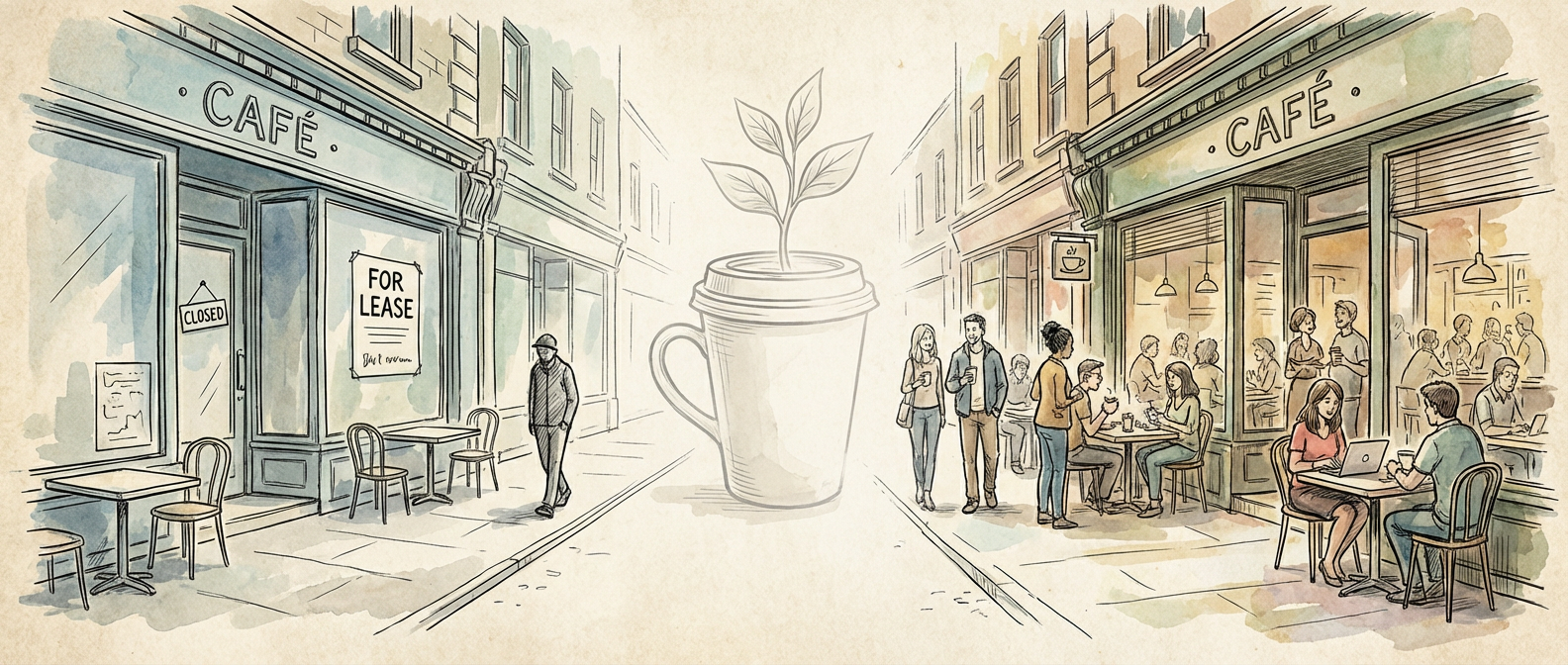
What I didn’t realize at the time was that I was watching a broader collapse unfold in real-time. The National Coffee Association’s 2025 survey paints a stark picture: independent café closures across the United States jumped 18 percent year-over-year, with over 4,200 independent shops shuttering their doors between January and October alone. That’s not just a business metric. That’s infrastructure disappearing. That’s gathering places turning into luxury condos or another chain storefront selling the same mediocre beverage in every city from Portland to Miami.
The Death of a Concept Nobody Remembers Learning
Most people have never heard of Ray Oldenburg, but they’ve lived in the world he tried to describe. In 1989, Oldenburg published “The Great Good Place,” a sociological meditation on the importance of informal public gathering spaces. He called them “third places” to distinguish them from home (first place) and work (second place). These were the cafés, bars, barbershops, and community centers where civic life actually happened. Where ideas collided. Where strangers became acquaintances and acquaintances became friends. Where culture was debated, created, and refined through actual human interaction rather than through algorithm-curated feeds.
Oldenburg’s framework feels almost quaint now, but it’s made a comeback in academic circles precisely because we’re losing these spaces at an accelerating rate. Researchers at MIT Media Lab’s 2025 third place decline study found that third-place density in major U.S. metropolitan areas has dropped 22 percent since 2020. That’s a measurable, quantifiable erosion of the physical infrastructure that used to bind communities together. And unlike the rhetoric about “building community online” that dominated the early 2020s, there’s no digital equivalent for the kind of serendipitous encounter that happens when you’re physically present in the same room as other people who are also paying attention.
The Loneliness Data That Should Terrify Urban Planners
We’re living through an epidemic of isolation that policy makers refuse to name as such. The Pew Research Center 2025 loneliness report found that 47 percent of adults under 35 now report chronic loneliness, a staggering jump from 30 percent in 2019. That’s not a marginal shift. That’s nearly half of an entire generation describing their emotional experience as one of persistent isolation. Researchers have begun tracing correlations between this loneliness surge and the loss of informal gathering spaces, though most mainstream media coverage treats them as separate phenomena rather than as cause and effect.
The math is straightforward: fewer cafés means fewer reasons to leave your apartment. Fewer public gathering spaces means fewer opportunities for the kind of low-stakes social interaction that used to be the default texture of urban life. You can’t replicate that in a Discord server or a group chat. The serendipity is gone. The randomness is gone. The possibility of meeting someone who will change your perspective because they happen to be reading a book you’ve always wanted to discuss is gone.
How Rent Economics Are Weaponized Against Culture
The closure of Monmouth Coffee’s two London locations in early 2025 was a turning point that many industry observers marked as the moment third places became genuinely endangered. The café had been a cultural institution, the kind of place that shaped neighborhoods rather than merely occupying real estate within them. The reason given was blunt: commercial rent in Borough Market had increased 40 percent since 2022. In two years. That’s not market fluctuation. That’s predatory pricing designed to extract maximum value from every square foot of urban land.
This is the real mechanism of gentrification, and it operates with the quiet efficiency of a guillotine. The café owner who actually cares about the space, who knows regulars by name and takes pride in the quality of espresso and the diversity of conversation, can’t compete with a chain that has institutional capital and venture funding. The locally-owned bookshop gets replaced by luxury apartments. The dive bar becomes a wine bar. The community center becomes whatever real estate speculators think will generate the most return on investment. And slowly, the fabric of urban culture shifts from something organic and messy and genuinely interesting to something curated, packaged, and safe.
What’s Rising From the Ashes: The Anti-Café Insurgency
There’s something darkly funny about how capitalism responds to market failure by inventing new market categories. The “anti-café” model, which originated in Eastern Europe and charges customers by the hour rather than requiring continuous beverage purchases, saw a 60 percent surge in new openings across U.S. cities in 2025. On the surface, this seems like a solution. A way to create third places without depending on the economics of food and beverage service. But something is fundamentally different about a space that runs on an hourly billing model rather than the implicit social contract of the traditional café.
The traditional café is a space of low-pressure belonging. You buy a coffee and you can stay for three hours or three minutes. You’re not being monetized by the minute. You’re not being tracked. But the anti-café model, for all its cleverness, transforms the third place into a service, something you consume rather than something you inhabit. It’s entrepreneurship solving a problem by turning a solution into a product, which is how we end up with cultural innovation that feels like loss disguised as progress.
Where Do We Go From Here
I don’t have a redemptive ending for this essay, and I won’t insult you by pretending I do. What I know is that something real and important is being destroyed, and it’s happening quietly enough that most people don’t notice until they realize they can’t remember the last time they had an unplanned conversation with a stranger that actually mattered. The closures will continue. The rent will keep rising. The cities will keep optimizing themselves into homogeneity and sterility. But people are remarkably stubborn about wanting to be around other people, and underground culture, genuine community, and spaces that actually reflect the complexity and weirdness of real human life tend to find a way to persist, even if it means getting creative about where and how they operate.
What have you noticed disappearing from your own neighborhood? What third places have you lost, and what unexpected ones have you found emerging in their place? The conversation about how we rebuild public culture in an age of extreme property speculation is only beginning, and it needs voices that actually understand what’s at stake. Tell me what you’re seeing.