
When the Algorithm Got a Voice
There’s a moment, usually around 3 AM in some converted warehouse in Brooklyn or Berlin or Melbourne, when you realize that the DJ you’ve been listening to all night isn’t actually selecting records anymore. They’re just standing there, occasionally adjusting something on their laptop while an AI system they licensed three months ago does the actual curation work. This isn’t a hypothetical anymore. This is the cultural rupture we’re living through right now, and it’s messier than anyone expected.
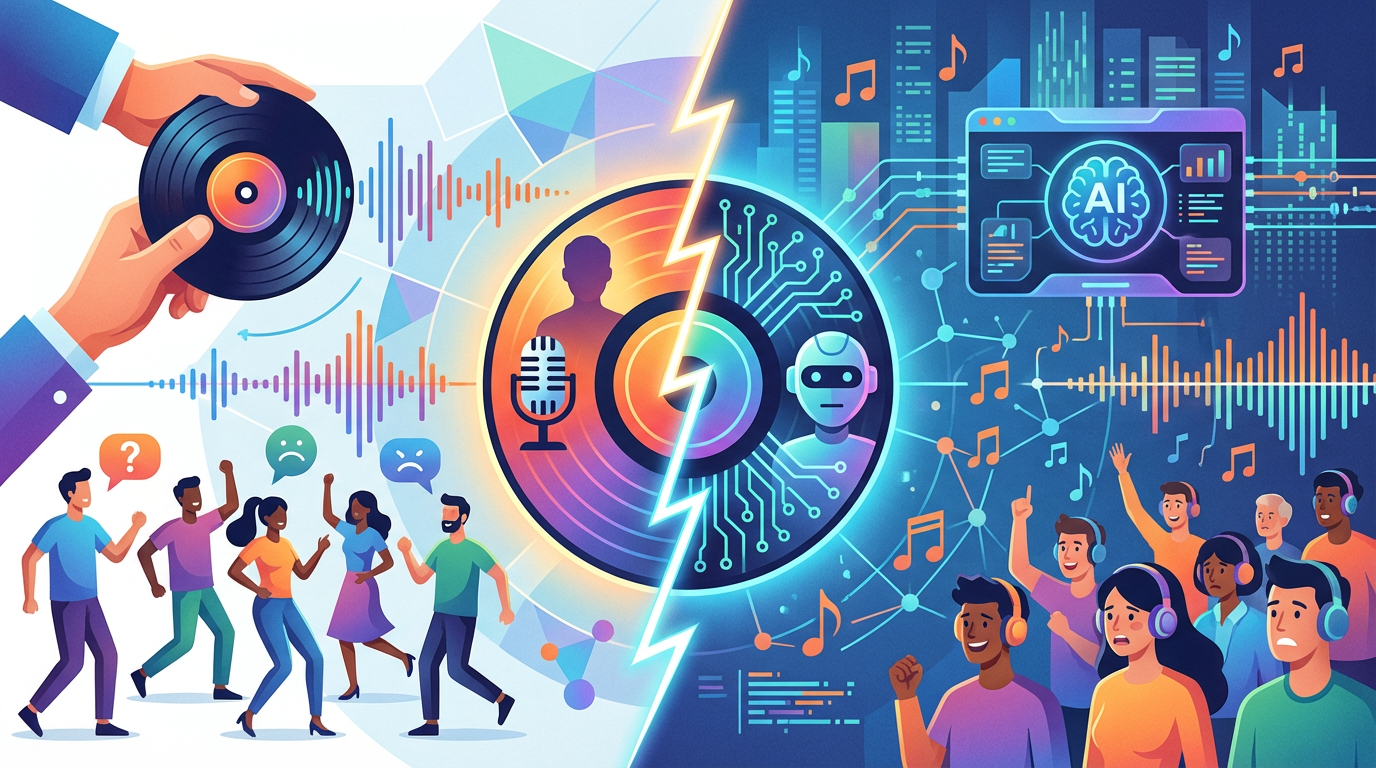
When Spotify rolled out AI DJ Pro globally in mid-2025, the streaming giant was running a familiar playbook: democratize, scale, optimize. The feature uses a voice-guided model built on technology they acquired when they brought Sonantic into the fold, creating something that genuinely sounds like a person talking to you about music. Within 90 days, over 100 million listeners were using it. That’s not just adoption. That’s cultural infiltration. According to Spotify Investor Relations Q3 2025, these weren’t anomalies or early adopters kicking the tires on something novel. They were mainstream music listeners making a genuine choice about how they wanted their discovery experience mediated.
The Narrowing: What Research Is Actually Showing
Here’s where the optimism starts to curdle. A University of Oslo study published in January 2026 tracked what happens when people let algorithms do the heavy lifting for extended periods. The results are straightforward enough to feel alarming: listeners who engaged with AI-curated playlists for more than 15 hours weekly showed a 27 percent reduction in exposure to artists outside their pre-existing taste preferences. That’s not a subtle number. That’s the algorithmic equivalent of a musical echo chamber actively shrinking.
What makes this particularly insidious is that it doesn’t feel like limitation. It feels like refinement. You get music you like more often. The system learns your taste and becomes more efficient at delivering exactly what you want. But efficiency in music discovery and actual musical growth are two completely different things. The records that changed you as a listener, the ones that shifted your entire perspective on what music could do, almost never came from expecting them. They came from friction. From someone at a record store making an unexpected recommendation, or a DJ playing something that shouldn’t work but does, or stumbling into a subgenre you didn’t know existed.
The Trust Collapse
Listener sentiment has shifted dramatically in recent years. Pitchfork’s 2025 reader survey found that 58 percent of respondents said they actively distrust algorithm-generated discovery, up from just 31 percent in 2022. That’s not gradual skepticism. That’s active, polarized rejection happening in real time. Something flipped in how music listeners think about the systems mediating their culture.
Part of this comes from saturation fatigue. The DistroKid Creator Economy Report 2025 revealed that AI-generated tracks now represent 14 percent of all submissions to their platform as of October 2025. That percentage might sound modest until you consider what it actually means: one out of every seven new songs hitting the distribution infrastructure is algorithmically composed. The catalog is expanding at a velocity that human attention spans can’t possibly keep pace with, and listeners sense that. They sense the dilution.
Where Human Touch Became a Form of Resistance
This is where the rebellion gets interesting. SoundCloud reported a 19 percent increase in human-curated playlist followers during 2025, which they directly attributed to backlash against AI curation in their creator economy analysis. That’s not just nostalgia for an old format. That’s active preference. People are choosing the slower, more intentional curation of other humans over the optimized efficiency of machines. They’re willing to sacrifice algorithmic precision for genuine perspective.
What’s fascinating is where this preference is actually coming from. Not primarily from music industry gatekeepers or aging analog purists. It’s younger listeners, people who grew up with algorithmic mediation, who are rejecting it as a primary discovery mechanism. They’ve experienced enough years of the algorithm that they understand its limitations instinctively. The AI DJ might know what you like, but it doesn’t know what you need. It doesn’t take risks. It doesn’t challenge. It doesn’t have a perspective shaped by life experience, or a genuine reason to care why a particular record matters right now.
The Fork in the Road
We’re at a real inflection point where different music communities are making fundamentally different choices about how they want to engage with discovery and curation. Some listeners are going deeper into algorithmic optimization, finding comfort in systems that reflect their preferences back with increasing precision. Others are retreating toward human-curated spaces, independent playlists, and communities built around specific perspectives rather than aggregate data.
Neither choice is wrong, exactly. But they’re pointing toward genuinely different futures for music culture. One leads toward increasingly personalized, increasingly narrow sonic worlds where we hear things we already like delivered with perfect timing. The other preserves friction, serendipity, and the possibility of genuine surprise. The stakes matter because music has always been about more than consumption. It’s been about shared reference points, about the cultural conversations that emerge when people are exposed to similar things. When those discovery pathways splinter completely, something shifts in how culture itself functions.
The question that matters most isn’t whether AI curation is good or bad technology. It’s who gets to decide what role it plays in your musical life, and whether that decision stays an active choice or gradually becomes the default you stop questioning. What’s your current relationship with algorithmic discovery? Has it changed how you actually engage with new music?