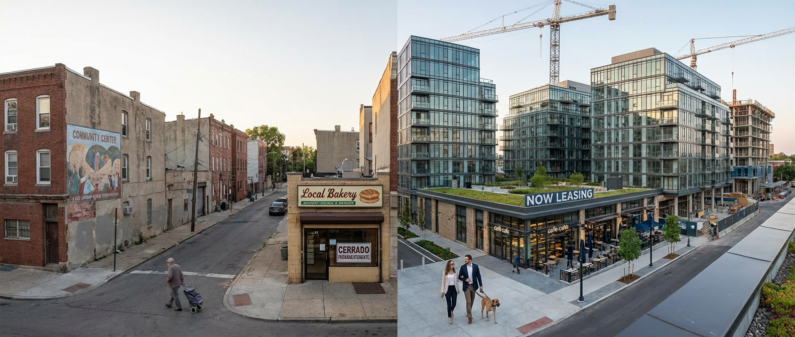
The Mathematics of Cultural Death
There’s a moment in every cultural ecosystem when the economic pressures that will eventually destroy it first become visible. For Brooklyn’s warehouse scene, that moment wasn’t when the luxury condos started rising or when the first artisanal coffee shop opened its doors. It was when 285 Kent Avenue, the legendary venue that hosted everyone from Patti Smith to Grimes before they were household names, received its final eviction notice in 2014.

The closure of 285 Kent was more than the loss of a single venue. It ended what urban theorists call the “cultural production cycle”, that delicate period when low rents, loose regulations, and artist migration create the perfect conditions for genuine creative innovation. The math is brutal: as soon as a neighborhood becomes known for its culture, the economic forces that enabled that culture begin systematically dismantling it.
What made 285 Kent special wasn’t just its 40,000 square feet of raw industrial space or its legendary sound system. It was the broader ecosystem of cheap rehearsal studios, affordable artist housing, and the critical mass of broke creatives who could afford to take risks because their overhead was manageable. When a warehouse show only needs to sell 200 tickets to break even, experimentation becomes possible.

The Architecture of Underground Economics
The cultural peak of early 2010s Brooklyn didn’t emerge from nowhere. It required specific material conditions that developers and city planners consistently fail to understand or replicate. Post-industrial neighborhoods like Williamsburg and Bushwick had something increasingly rare: large, flexible spaces at prices that allowed artists to fail gracefully.
The economics were as important as the aesthetics. A band could rent a practice space in a converted factory for $300 a month, split between four members. Promoters could book venues without insurance requirements or noise complaints derailing every show. Artists could live in shared lofts for $600 a month, giving them the financial breathing room to spend years developing their craft without the pressure to immediately monetize every creative impulse.
This infrastructure wasn’t an accident. It was the direct result of decades of disinvestment and industrial decline that left entire neighborhoods with abundant cheap space and minimal oversight. The irony is that the moment these areas began producing culture that captured wider attention, the very conditions that made that culture possible started disappearing.
The transformation happened with algorithmic precision. First came the early adopters, artists and musicians drawn by cheap rent and flexible spaces. Their presence created a scene, which attracted more artists, which eventually attracted media attention and cultural tourists. Each wave of newcomers bid up rents incrementally until the original creative community could no longer afford to stay.
The Commodification Timeline
There’s a predictable lifecycle to how neighborhoods transition from cultural incubators to cultural museums. The process typically unfolds over eight to twelve years, with each phase systematically eroding the conditions that enabled the previous one.
Phase one is pure necessity. Artists move to forgotten neighborhoods because they literally cannot afford anywhere else. They create their own infrastructure out of desperation: illegal venues in basements, pop-up galleries in abandoned storefronts, house shows in railroad apartments. The culture that emerges is raw and unfiltered because there’s no commercial apparatus to smooth its edges.
Phase two brings legitimacy and visibility. A few venues get proper permits, some galleries open with actual business licenses, local blogs start covering the scene. This is when the most innovative work often happens. There’s enough infrastructure to support ambitious projects, but not so much commercial pressure that risk-taking becomes impossible.
Phase three introduces the first wave of cultural tourists and speculative investment. Property values start climbing, longtime residents begin getting priced out, and venues face increasing pressure to book commercially viable acts. The neighborhood still produces interesting work, but the focus shifts from creation to curation.
Phase four is the museum phase. Expensive cocktail bars themed around the neighborhood’s former grittiness, luxury apartments marketed to buyers who want to live somewhere “authentic,” and cultural venues that book nostalgia acts for audiences who can afford $75 tickets.
The Impossible Economics of Alternative Space
Here’s the fundamental contradiction: the qualities that make neighborhoods culturally fertile, low rents, loose regulations, economic marginality, are precisely what successful cultural production eliminates. Every great underground venue ultimately sows the seeds of its own destruction by making its neighborhood desirable.
This isn’t just a New York phenomenon. The same pattern has repeated in London’s East End, Berlin’s Kreuzberg, Los Angeles’s Arts District, and countless other cities where industrial decline created temporary cultural opportunities. The problem isn’t individual greed or poor planning. It’s the structural impossibility of maintaining artificially low rents in market economies once an area becomes desirable.
The venues that survive gentrification are either those that achieve institutional status early enough to secure favorable leases, or those that successfully transition to serving wealthier audiences. The experimental spaces, the all-ages venues, the places where unknown artists could afford to book shows? These almost always disappear.
What’s particularly insidious is how the cultural infrastructure gets replaced by its aesthetic signifiers. Expensive restaurants open in spaces that used to house rehearsal studios, using exposed brick and industrial fixtures to evoke the grittiness they displaced. Luxury developments get names like “The Factory” or “The Warehouse” while having none of the flexible, affordable space that made actual factories and warehouses culturally productive.
After the Gold Rush
The artists and musicians who created Brooklyn’s cultural moment didn’t simply vanish when the rents became unaffordable. They migrated to new peripheries. Some moved to Queens, others to Philadelphia or Detroit or smaller cities where the economics of cultural production remain viable. The infrastructure follows these migrations: practice spaces, venues, communities of mutual support rebuilding themselves wherever conditions allow.
Understanding these cycles doesn’t make them less destructive, but it does reveal the broader patterns at work. The neighborhoods currently being “discovered” by cultural media, Ridgewood, the South Bronx, parts of Philadelphia and Baltimore, are following predictable trajectories. The question isn’t whether they’ll eventually face the same pressures, but whether we can develop models that preserve cultural accessibility as neighborhoods develop economically.
The real tragedy of 285 Kent wasn’t just the loss of one venue, but the dissolution of an entire ecosystem built around accessible cultural production. What emerges in gentrified neighborhoods is often polished and professional, but it rarely recreates the conditions that allow unknown artists to take meaningful risks. We end up with cultural consumption replacing cultural creation, aesthetic appreciation substituting for active participation.
The next wave of cultural innovation is already happening somewhere else, in spaces that current arbiters of taste haven’t yet discovered. If you know where that is, congratulations. You have maybe five years to document it before the cycle begins again.